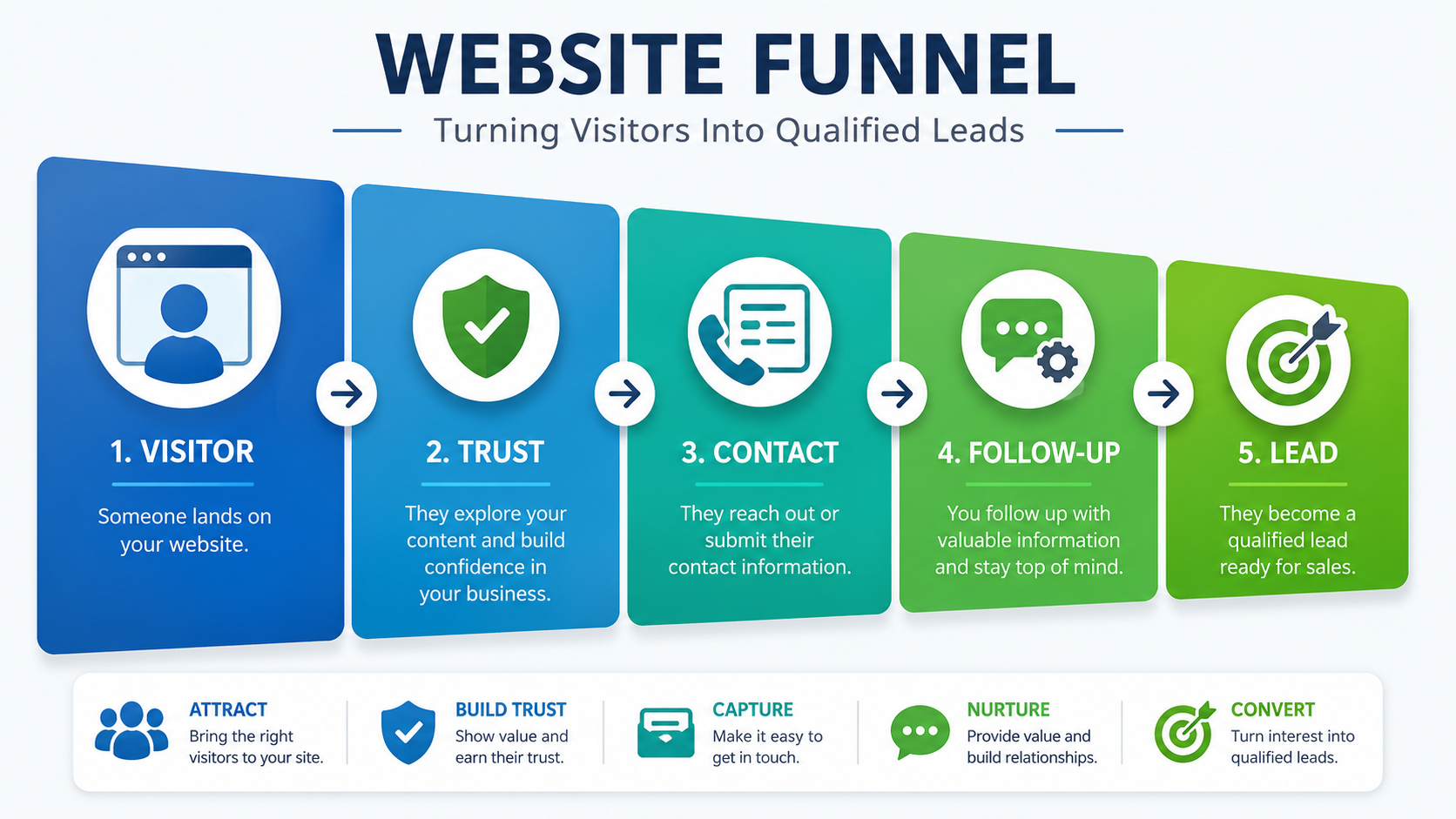

How to Turn a Website Into a Lead-Generation System
Visitor → Trust → Contact → Follow-up → Lead

Many businesses have a website, but not all websites generate leads.
Some websites look nice but do not explain the business clearly. Some have service pages but no strong call to action. Some get visitors but do not capture contact information. Others have forms, but no follow-up process.
A lead-generation website is different.
It is built to help visitors understand, trust, and contact your business.
Step 1: Make the message clear
The first job of your website is clarity.
Within a few seconds, visitors should understand:
- What you do
- Who you help
- What problem you solve
- Why they should trust you
- What step they should take next
Avoid vague headlines like “We help you succeed” or “Innovative solutions for your business.” Those statements sound professional, but they do not explain enough.
Be specific. For example:
“Websites, SEO, and automation for small business growth.”
That is clearer than:
“Digital solutions for the modern world.”
Step 2: Build service pages that answer real questions
Each major service should have its own page.
If you offer websites, SEO, content, review management, listing management, automation, or consulting, each one deserves a clear explanation.
A strong service page should include:
- What the service is
- Who it is for
- What problems it solves
- What is included
- Why it matters
- Frequently asked questions
- A clear call to action
This helps both customers and search engines understand your business.
Step 3: Add trust signals
People rarely contact a business based on a homepage alone. They look for trust signals.
Trust signals may include:
- Founder story
- Real experience
- Client examples
- Certifications
- Case studies
- Reviews
- Clear contact information
- Professional branding
- Consistent online listings
- Helpful educational content
For a new business, you may not have many testimonials yet. That is okay. Start with real founder credibility, clear process, and transparent service descriptions.
Step 4: Use strong calls to action
Every important page should guide the visitor.
Examples:
- Book a Strategy Call
- Request a Website Review
- Get a Free SEO Audit
- Contact Digital Paragon
- Start Your Digital Growth Plan
Do not make visitors guess what to do next.
Also, avoid having too many competing CTAs. One primary CTA is usually best.
Step 5: Capture leads properly
A contact form should be simple, but useful.
Ask for:
- Name
- Phone number
- Business name
- Website URL
- What they need help with
Do not make the first form too long. The goal is to start the conversation.
Also make sure forms are tested. A broken form can quietly cost you leads.
Step 6: Follow up
This is where many businesses lose opportunities.
If someone fills out a form, downloads something, or asks for information, there should be a follow-up process.
That may include:
- Confirmation email
- Internal notification
- CRM entry
- Follow-up reminder
- Review of the customer’s website
- Personal reply
- Appointment scheduling link
Automation can help, but the follow-up should still feel personal.
Step 7: Measure and improve
A lead-generation website should be reviewed over time.
Look at:
- Which pages get traffic
- Which pages generate inquiries
- Where visitors drop off
- Which CTAs get clicks
- Which services attract interest
- Which search terms bring visitors
The goal is not perfection on day one. The goal is continuous improvement.
How Digital Paragon helps
Digital Paragon helps businesses turn websites into stronger growth foundations by connecting design, SEO, content, automation, and lead-generation strategy.
We focus on practical execution: clear messaging, better structure, stronger visibility, and smarter follow-up.
Final thought
A website should not just exist.
It should explain your value, build trust, capture interest, and support follow-up.
That is how a website becomes a lead-generation system.